Case Study
How Pinpoint Medical is Transforming Prostate Cancer Diagnostics With a 15-Minute Urine Test
Every year, 12,000 men in the UK die from prostate cancer. Despite an almost 99% chance of survival in the early stages, the current pathway to diagnosis can be slow, inaccurate and invasive. This makes earlier detection difficult.
Pinpoint Medical is trying to change that.
Based at Carus House, the West of Scotland Science Park’s sister premise in Clydebank, the team is developing precision technology to help diagnose prostate cancer in earlier stages.
Diagnosing cancer earlier and more accurately
Driving Pinpoint Medical’s mission is the need for more accurate methods of detecting prostate cancer.
“We're still dependent on something called prostate-specific antigen (PSA),” explains Chief Technology Officer Affar Karimullah. “That's a little protein in blood which, if it's elevated, tells us you may have prostate cancer.”
But the high number of false positives from PSA tests can lead to bottlenecks, such as long waits for MRI machines. And MRIs can pick up things which may not be cancer, often leading to unnecessary biopsies.
Using biosensing technology, Pinpoint Medical is developing tests that can more accurately detect prostate cancer from urine. Polymers detect certain molecules with high sensitivity and specificity, meaning specialists don’t need to use large lab equipment.
“You go to the GP. You may have had a consultation. They say: ‘Just wait here, give us a urine sample.’ And 15 minutes later, you find out whether there’s a chance you may have prostate cancer.”
From academic research to clinical innovation
The company was founded in 2018 by Chief Executive Officer Jason Donnelly, with the vision to develop new technology for healthcare. But it wasn’t until 2024 that “things came together.”
Affar came on board in 2023, bringing his own research in biosensing technology. Together with adviser Professor Roy Vellaisamy, whose research on polymers and prostate cancer formed the basis of the prostate cancer test, the team secured the licensing and intellectual property needed to take the technology forward.
“Jason and I managed to raise funds in 2024 to move this forward, and I put a team together here to do the R&D.”
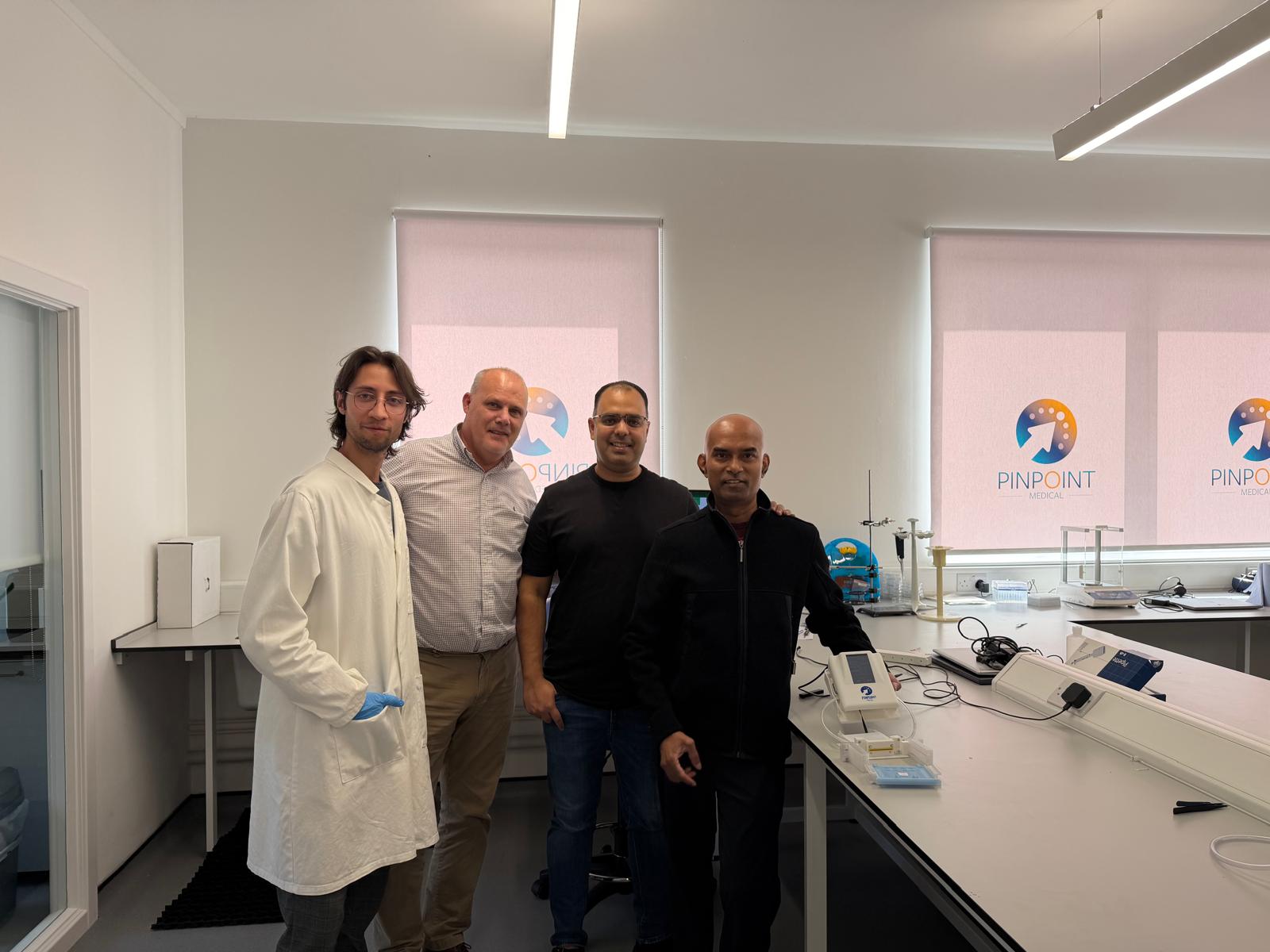
The company now has three scientists working in the R&D team at Carus House, refining the technology and product design needed to bring the diagnostic platform closer to clinical use.
Why Carus House?
Pinpoint Medical’s move to Carus House in 2026 marked a major milestone in the company’s journey, as it moved closer to clinical trials.
Leaving its original base at the University of Glasgow gave the company space for the right equipment and the ability to meet the safety standards required.
“We need to have the same lab space through the whole trial and must stay consistent.”
After looking at a few commercial spaces, the company chose Carus House in Clydebank.
“The laboratory had all the equipment we wanted, especially a fume cabinet. We felt like we would very quickly get off the ground in this facility without the need to install bench spaces.”
Pinpoint Medical also benefits from being close to the University of Glasgow and having the Golden Jubilee National Hospital on its doorstep.
“As we start getting clinical samples, that becomes a really convenient delivery point for us.”
Hitting milestones and raising funds: What’s next for Pinpoint Medical?
2026 has been a year of strong progress for Pinpoint Medical. With its laboratory now set up, it’s focused on hitting the milestones needed to move its prostate cancer diagnostic towards clinical application.
“We’ve got a new facility. We now need to hit our milestones and raise the next tranche of funding.”
The current facility also provides Pinpoint Medical with the capacity to expand in the near future.
“Expansion is an important part of [our plans]. Having the capability in the building to do that is important.”
A long-term vision for improving diagnostics
The company’s goal is clear: “What we want to do here is improve the chances of people surviving prostate cancer.”
But the company’s ambition extends beyond a single prostate cancer test. Ultimately, Pinpoint Medical’s goal is to develop platforms that can test for diseases without much lab work.
“We have another optical sensor for larger molecules like proteins and viruses, and that can be deployed for those applications.”
We’re proud to be supporting Pinpoint Medical as it works to change the future of diagnostics. Find out more about the company here: www.pinpointmedical.co.uk.